

How We Scaled our Non-Profit Across Cities Without Duplicating Services
In the social impact and non-profit sectors, expansion is too often treated like corporate market acquisition. Organizations raise capital, enter a new city, plant their flag, and immediately begin competing with existing grassroots programs for local philanthropic dollars.
The result is systemic fragmentation. Instead of multiplying impact, organizations build isolated islands, replicate services that already exist, and leave vulnerable youth navigating a maze of disconnected providers.
When R3 Generations began exploring an expansion beyond San Antonio, our board chair, Angela Williams, and our leadership team established a clear directive:
“Do not go to Dallas to build an island. Go to build bridges.”
Scaling an organization should never be an exercise in organizational ego. If a community is already serving youth effectively in a specific area, duplicating that work is an inefficient use of resources. True expansion is about identifying where youth are falling through systemic cracks and offering specialized infrastructure to strengthen the existing community ecosystem.
Here is the exact framework we used to scale from our West Side San Antonio roots into Dallas, expand our reach to nearly 500 youth, and graduate over 75 students through the juvenile probation system in our very first chapter.
Step 1: Listen to the Data and Map the Unmet Gaps
We did not target Dallas because of a board retreat or an opportunistic grant. We went because the community called us there.
Near the end of 2024, an undeniable pattern emerged in our inbox. Grow with Google reached out trying to locate an educational provider for a student relocating to Dallas. That exact same day, a case manager contacted us about a foster care youth in San Antonio being transferred to North Texas who desperately needed to complete their accredited high school credential. Within hours, several separate inquiries pointed directly to the Dallas–Fort Worth area. Instead of assuming we had the answers, we initiated a listening campaign.
I researched the DFW youth landscape and compiled a targeted list of 30 youth-serving organizations. I sent a transparent introduction to every single one. The core message was straightforward:
"We are an outreach organization based in San Antonio providing afterschool programming, workforce development, certifications, and accredited high school diplomas. We are not looking to duplicate what you do. We want to know: Are there gaps where our programming can support the students you already serve?"
Out of 30 emails, 26 went unanswered. But the four leaders who responded did not just reply—they recognized a shared mission. Three of those organizations—immediately signed Memorandums of Understanding (MOUs) to partner with us.
Then came the fourth reply.
Step 2: Form Anchor Coalitions Around Radical Generosity
The fourth email was from Lisa Mumford, Director of Children and Youth Services at Juliette Fowler Communities.
When we hopped on our first video call, I had a presentation prepared to pitch our service model. I barely finished introducing myself before Lisa stopped me. She had already researched our history, reviewed our press coverage, and watched our feature on NBC's TODAY Show. She looked through the screen and delivered words that permanently shifted our trajectory:
"R3 belongs in Dallas. You have to be here. We have the space; you come and do what you do, and we’ll provide everything."
Juliette Fowler Communities has over a century of storied service in Dallas. Rather than viewing a young organization from San Antonio with suspicion, they offered radical collaboration. They did not demand administrative overhead or create turf wars. They opened their campus and invited us to build a home together.
Step 3: Persevere Through the Crucible of Growth
Milestones are rarely achieved in easy seasons. Progress is frequently tested in the fires of personal adversity. In the spring of 2025, our team packed our bags to make our first official site visit to Dallas to walk the Fowler grounds. Right after arriving, while standing in the middle of a store, my phone rang. It was my father.
My grandfather—the man who taught me what faith looked like and whose church planted the DNA for R3—was taking his final breaths. We turned the car around immediately and began the hurried drive back down I-35 to San Antonio. Tragically, I did not make it back in time to say goodbye. Only days before, our church had also lost a beloved member, Blanca, to cancer.
In a single three-day span, Angela Williams and I wrote two obituaries, coordinated two services, and officiated both funerals at the exact same hour on the same day in different locations. At that exact moment, my brother and his wife were in the hospital welcoming the birth of their first daughter.
Life, death, and legacy collided all at once.
We buried my grandfather on Saturday. By Monday morning, Angela and I were back at our desks. We rescheduled our Dallas tour, drove back up I-35, and refused to let grief derail the calling. When Lisa walked us through the second floor of East Dallas Christian Church, we saw a room already painted blue, a stage ready for future high school graduates, and an open floor plan that felt instantly like home.
Within three weeks, Fowler had the entire floor furnished. We established a computer and tutoring lab, a clothing boutique in partnership with San Antonio Threads, partner meeting rooms, and a dedicated counseling suite to provide free mental health therapy for every enrolled student.
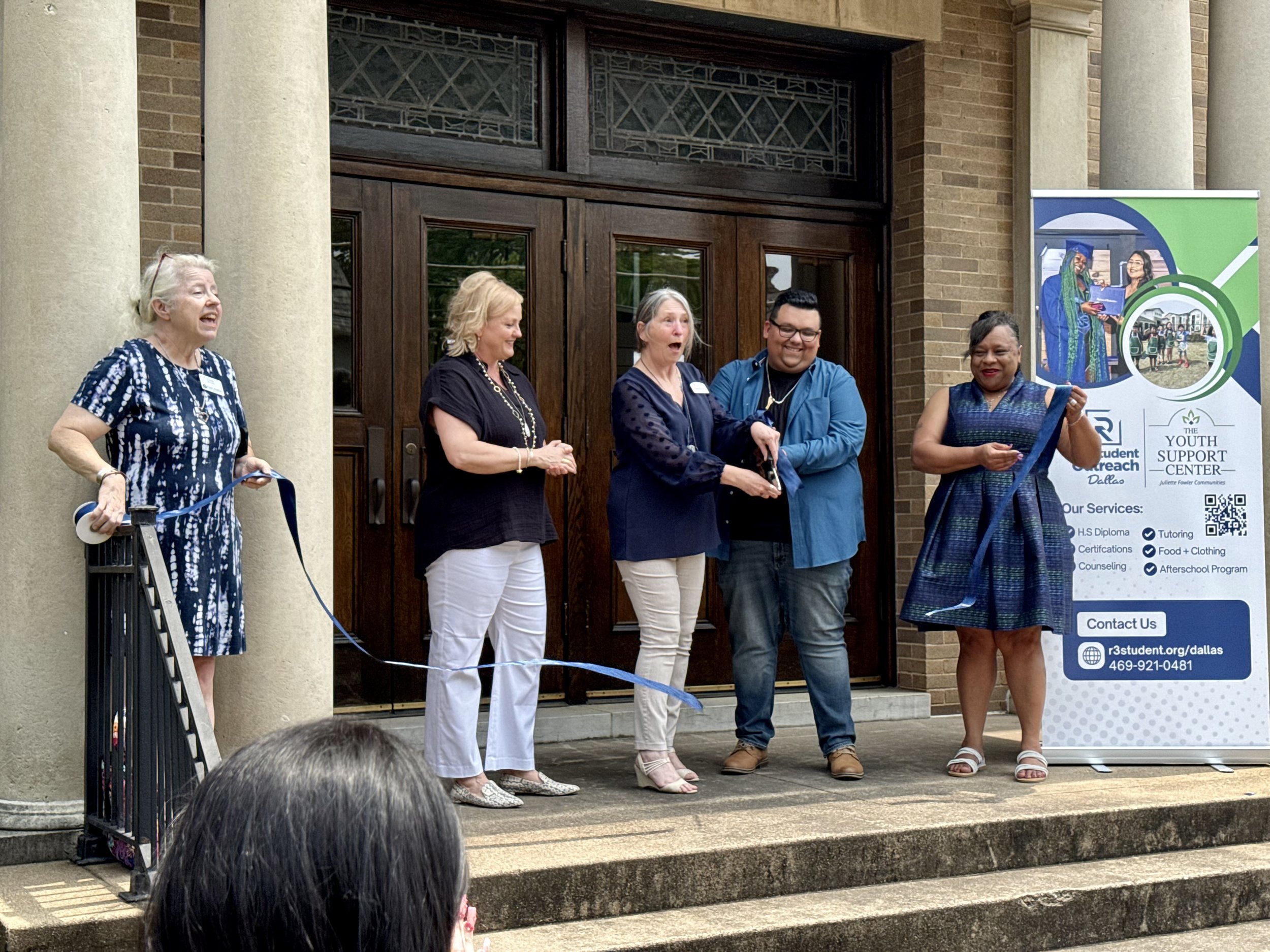
On May 20, 2025, we cut the ribbon on the Juliette Fowler and R3 Youth Support Center.
Step 4: Endure the Ground-Level Operational Grind
A strategic plan on paper means nothing without operational grit.
Since our grand opening, our team has executed the "Tuesday Run" without fail. Every Tuesday morning, our alarm rings at 4:00 AM. We pack our personal vehicle, make our traditional stop at Buc-ee's for breakfast burritos, and drive 270 miles north. We work a full operational day on-site mentoring youth, conducting classes, and coordinating with probation officers until 5:00 PM, before driving back home to San Antonio—often pulling into our driveways past midnight.
That is 476 miles round-trip every single week. That is 22,848 miles a year on my personal engine.
Earlier in our journey, when we expanded to our second San Antonio center at Rolling Oaks Mall, I used to worry about the 45-minute daily commute. Standing in Dallas months later, I had a sudden realization: If we couldn't be trusted with a 45-minute drive across town, how could we ever be trusted with a four-hour drive across Texas?
Faithfulness in small steps prepares the capacity for regional impact.
The Outcome: Measurable Generational Trajectory
By refusing to duplicate services and embedding directly into existing juvenile justice and community networks, the impact was immediate:
500 Youth Served: Providing wraparound casework, free professional counseling, boutique clothing, and emergency aid.
75+ High School Graduates: Working directly with the Dallas Juvenile Probation Office to help justice-involved youth earn regionally accredited WASC diplomas through NuGenerations Private Schools.
Zero Duplication: Every program we operate complements local partners, routing students into employment pipelines without competing for local operational territory.
Horizons: The National Blueprint
Dallas has proven that our model is scalable across state lines.
We are actively preparing to deploy this collaborative blueprint into high-need hubs across the country:
Chicago: Supporting a city where 65% of youth aging out of foster care face immediate housing instability, and juvenile recidivism sits at 32%.
New Orleans: Reaching an area where 16.2% of young adults are disconnected from school or work, and youth poverty in the Lower Ninth Ward exceeds 45%.
Atlanta: Confronting severe social mobility gaps where low-income youth face a 4% chance of escaping generational poverty.
To every non-profit director, foundation officer, and municipal leader looking to solve youth disconnection: Stop operating in silos.
Look at the organizations already fighting in the trenches. Find partners who are willing to sit down, dream together, and offer what they have. When you trade competition for radical partnership, you stop managing poverty and start building generational revival.
Don't quit now.
#NonProfitStrategy #StrategicPartnerships #DallasYouth #ScaleForImpact #R3Generations #YouthEmpowerment #CollaborativeLeadership